

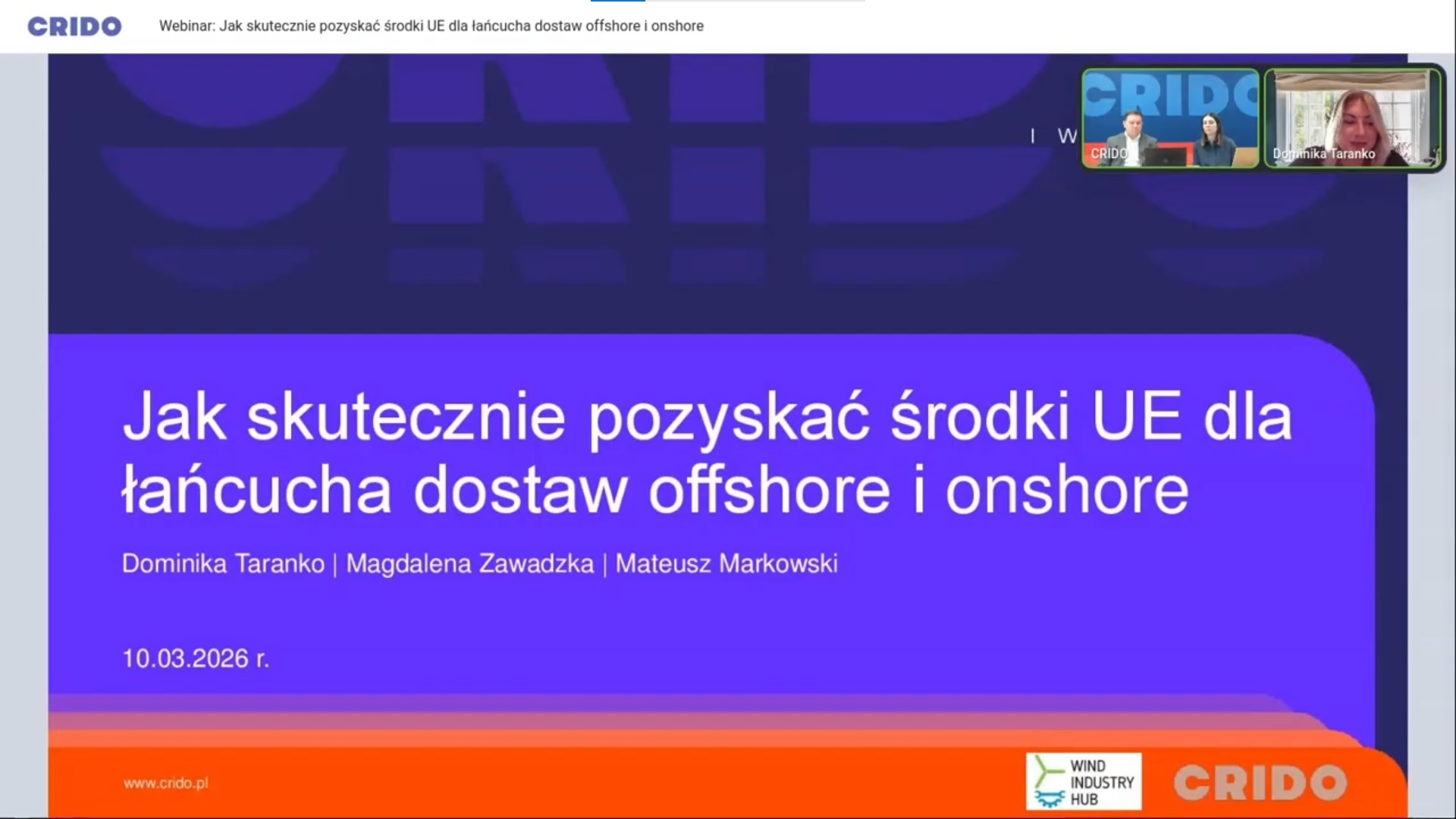
The growing importance of the green technology sector and the rapid expansion of the wind energy industry mean that companies operating within the supply chain for offshore and onshore projects are increasingly seeking external sources of funding for their investments and research and development projects.
This was the focus of a webinar organised by Wind Industry Hub and CRIDO, during which experts presented an up-to-date overview of available support instruments and practical tips on how to successfully apply for public funding.
During the meeting, Magdalena Zawadzka, a partner at CRIDO, and Mateusz Markowski, a senior manager, discussed both national and European funding programmes that can support the development of technologies and infrastructure related to the energy transition. Among the most important instruments highlighted were, among others, the SMART Path, a flagship programme supporting research, development and implementation projects by enterprises in Poland. The programme enables the financing of comprehensive projects covering both R&D work and production investments, as well as activities related to internationalisation and digitalisation. For companies in the wind energy sector and their suppliers, this is one of the key tools for developing new technologies and building manufacturing capabilities.
An important part of the webinar was also a presentation of funding opportunities at European level. Experts highlighted the growing importance of the Innovation Fund, one of the world’s largest programmes supporting the development of innovative low-carbon technologies. This fund enables the financing of large-scale projects that contribute to reducing greenhouse gas emissions and support the energy transition in Europe. In the context of the offshore and onshore sectors, it can support both the development of new component manufacturing technologies and investments in advanced energy solutions.
Webinar participants also learned about the objectives of the European Commission’s new initiatives, which will play an increasingly significant role in financing the green transition of industry in the coming years. One of these is the STEP programme (Strategic Technologies for Europe Platform), which aims to strengthen European technological capabilities in strategic areas, including the renewable energy sector and low-carbon technologies. The programme is designed to facilitate the financing of projects of strategic importance for Europe’s technological and energy security.
Experts also discussed the impact of new EU regulations on the availability of public support. Particular attention was paid to the state aid framework for industry, including the Clean Industrial State Aid Framework, which is intended to enable Member States to provide more flexible support for investments related to the energy transition and the decarbonisation of industry. In this context, the Industrial Acceleration Act is also of significant importance; this initiative aims to accelerate the development of industrial projects supporting the energy transition and the establishment of European supply chains for green technologies.
From an investor’s perspective, the new regional aid map is also particularly important, as it sets out the maximum level of public support for investment projects in specific regions of Poland. Careful planning of an investment’s location can significantly influence the level of available funding, which is crucial for the viability of large-scale manufacturing projects.
The webinar also provided practical guidance on preparing effective funding applications. Experts emphasised that success in grant competitions depends not only on the innovativeness of the idea, but also on precise project planning, a realistic budget and the skilful alignment of technological objectives with the priorities of funding programmes. Participants also learnt about the most common mistakes made by applicants and how to avoid them.
The meeting concluded with a networking session providing an opportunity to establish contacts and seek potential partners for consortium projects.